



As many of you (hopefully) know, the FDA has been getting pretty serious with sun protection over the past few years. New regulations for over-the-counter sunscreens are changing the way SPF is packaged, labeled, and presented to you. Why? Because sun protection is one of the most important steps we can take to protect the largest organ on our body.
“There’s an epidemic happening in skin cancer and sun care,” explains Deborah S. Sarnoff, M.D., Senior Vice President of The Skin Cancer Foundation. “For one, people are living longer. Statistically speaking, the older you get, the more prone you are to skin cancer.” But it’s a problem for the younger generation, too—Jersey Shore and the “tanning mom” scandal all remind us of how bronze-oriented a generation we are, and tanning beds are some of the worst offenders. Add a thinning ozone layer (thanks, chlorofluorocarbons!) and generally more exposed fashion trends, and you’ve created a catalyst for a wide range of skin-related issues, most notably, skin cancer. Melanoma and skin cancer are the most common form of cancer in the United States, with over two million diagnoses annually. “UV light also causes exponential aging—if you’re not going to listen to the cancer side, at least look at the aesthetic effects,” adds Susan Weinkle, M.D., president of the American Society for Dermatologic Surgery.
The FDA’s proposed regulations on sunscreen labeling attempt to both educate and elucidate—finally taking the confusion out of buying a bottle of SPF. Originally set to go into effect this June, the FDA recently announced that it will give sunscreen manufacturers until December 2012 to make the necessary changes (smaller companies get even more time). “It’s a challenge,” comments Dr. Weinkle on the delay. “You want manufacturers to speed up the bottle redesigns in time for summer, but on the other hand, you don’t want them to rush—they’ve got to cover the bases.” We briefly went over the new sunscreen guidelines last year, but with 2012’s summer sun already blazing, here’s a quick reminder of the most important things to look for as you scan your bottle of SPF.
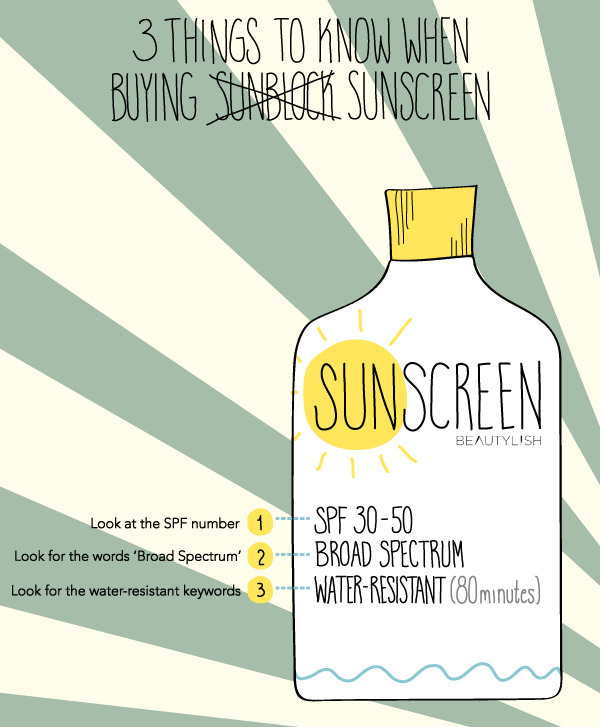
1. Look at the SPF number.
The FDA is banning manufacturers from labeling their products with a numerical SPF value higher than 50. Why? Because the amount of incremental sun protection you receive with a higher spf isn’t worth the added cost. “SPF 30 covers 97% of UV, SPF 50 covers about 98%—do you really need an SPF of 75 or 100? Not necessarily,” explains Dr. Sarnoff. “When you allow the numbers to go up, it becomes a contest among manufacturers—and the product cost rises for consumers.” Stick to the 30 to 50 range for all skin types, and you’ll be golden!
2. Look for the words ‘Broad Spectrum.’
According to the FDA’s new regulations, any bottle labeled with ‘Broad Spectrum SPF’ protects against both UVA and UVB light, and has passed the FDA’s broad-spectrum test. This applies to sunscreens SPF 15 and up. Since no product can effectively block out 100% of all UV light, no manufacturer can label their sun protection product as sunblock. From here on out, it’s all sunscreen.
3. Look for water-resistant keywords.
Sunscreens are no longer allowed to claim waterproof or sweatproof, and cannot claim to provide sun protection for over two hours. Only the term “water resistant” may now be used on labeling. Labels must include the duration of water resistance provided by the product in two time periods: 40 minutes or 80 minutes. “I recommend 80-minute formulations for sweating and swimming,” advises Dr. Sarnoff. “Spray formulas are a great idea for kids playing outdoors, but make sure you adequately cover the skin.”
Good Molecules: See a difference in your skin
You Might Also Like
-

Blemish & Acne Treatments
So Long, Summer Breakouts!
-

Sun Protection
3 Things to Know When Buying SPF This Summer
-

Sun Protection
FDA Sunscreen Update Part 1: Is SPF 30 enough?
-

Sun Protection
10 Beach Bag Beauty Must-Haves
-

Hair
How to Protect Your Hair Color from Sun Damage
-

Sun Protection
The Past, Present, and Future of Sun Protection Products
-

Sun Protection
5 Ways To Treat a Sunburned Scalp
-

Sun Protection
Best Facial Sunscreens